Are Wearables Still A Thing?

So the big Apple Event came, it saw, it conquered, more-or-less and left its faithful fan base clamoring for more.  Now that the new iPhone 8 and 8 Plus, iPhone X and the Apple watch, all set to drop either later this month or first part of November, have been unveiled, color me somewhat impressed but highly confused .  All the while, during the marketing, excuse me, press event…Freudian Slip; I kept asking myself a multitude of questions such as:  1) Would anyone really pay $999.00 plus tax for a phone? Come on, that’s like six or seven months worth of groceries.  2) Why is Apple making it seem like they were the first one to do many of these features?  I mean (fill in the blank) did this like (fill in the blank) years ago.  But the most important was, 3) Will the Apple watch actually do well; I mean, are wearables still a thing?  Apparently, Apple still thinks wearables are a thing, and based on previous years sales, they would be foolish not continuing the offering.  However, a question such as this requires more than surface viewing of sales in ascertaining whether wearables are still relevant.

In understanding the essence of this quandary, we must first be honest with ourselves in addressing that the mobile technology industry is utterly stagnant right now.  No longer are the days of 2007 to 2015, where breakthroughs and advancements define whether a device is cutting edge and worthy of consideration.  Now, mobile devices have become more about novelty, convenience, and fashion.  As such, companies are cashing in by placating more to our desires to have the “latest trends” as opposed to a device’s innovations and added value in our lives.  Don’t get me wrong, the usefulness of your cellphone remains a stable, as it is our life line in staying in touch with others, browsing the web for useful (or nonsense) information, or merely conducting your daily business affairs.  And that remains my point, ONE device should be the backbone of our productivity.  Believe me, wearables are slowly becoming their own stand alone entities, but can they replace the array of uses a cellphone offers?  My opinion is these are more a fashionable augmentations, but not necessities, and as such, definitely do not seem overtly relevant.  Doing this article made me think about Google Glass, one of the first major wearable, and how that was supposed to revolutionize the tech industry.  And it did, for a time, but the novelty wore thin as its pragmatism was superseded by the the more multi-purpose smartphone.  Let’s play the anecdote game, if you had a good car, would you buy a motorcycle?  I think many would answer “yes”, but what would be your reason?  Many would probably say, “Because having a motorcycle would be cool and fun.”  That is exactly the point, the motorcycle would be desired more for its novelty and enjoyment, less for its practical replacement of the automobile.  Some situation may cause this to vary, but overall, most would claim this to be the case.

Building off the notion of novelty versus necessity, we find ourselves at the corner of price and usefulness, while walking through these rough city streets searching for answers.  At launch, the Apple Watch 3 will debut with a $399 price tag, respectively, while its iPhone counterparts will start at $699 and $799.  As stellar and impressive as the Apple Watch 3 may be, is it overall utility equal or greater than its phone brethren, and the resounding answer of “no” seems obvious to me.  Though it can make/receive calls, play music, view/send text messages, can you honestly see yourself doing more?  Does writing or responding to an email seem plausible?  Watching video content for any period of time?  Playing a graphic-demanding game?  You probably found yourself with the conclusion of “no” to all or any combination of these questions.  And as such, the $399 price point proves disproportionate to usefulness/functionality comparative to its phone alternatives.  A more feasible price point for wearables would start at $15 (for items such as fitness trackers) and maxing out at the $200 price (for smart watches).  This is just my humble opinion, as it does not make sense for their pricing to be anywhere near that of a more encompassing phone.  My stance remains that until we reach a point when wearable pricing is comparable to its added value in our daily lives, I will continue seeing these as secondary technology, bought only if our wants outweigh our needs.  Or if a rich uncle just kicked the bucket and left us billions of dollars; whichever comes first.

After investigating the facts, the posed question still remains, “Are wearables a thing?” For me, the conclusion is this; they are a thing, but not a very relevant thing.  I have two smart watches still sitting in their packaging, and after playing with them a few times, found no practical uses in my daily grind.  But they do look hella cool!  Due to this, my beastly Huawei Mate 9 and sleek-as-hell LG G6 will continue being two pillars of productivity, sans making money and paying bills.  Oh, wouldn’t that be great if they could (sighs)?  Depending on which economist you read, we are either slowly recovering from a long recession or heading towards a great depression, meaning money is tight. Spend your money sensibly on the items that have more value adds in your life. For me, wearables are a novelty you acquire for the style, the convenience, or the simple enjoyment.  Not something that will make or break you!

ZTE Axon 7: A Six-Month Review

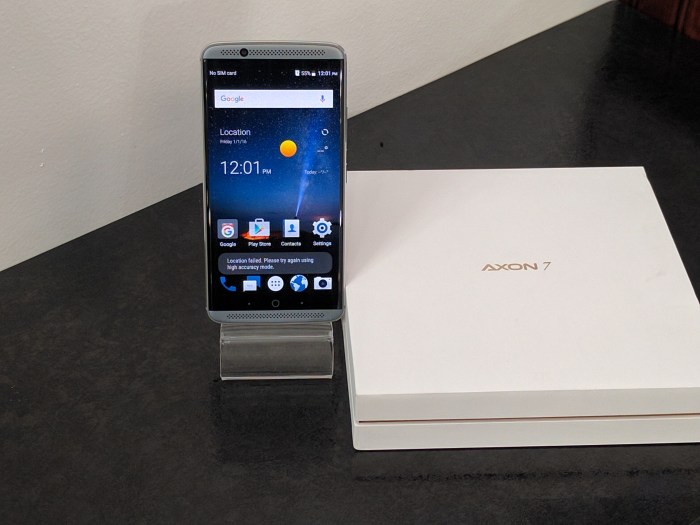
So, 2017 is finally upon us, and one of my New Year’s Resolutions remains giving credit where credit is due.  Because of this resolution, it is time to give credit to the folks at ZTE for engineering a magnificent device, full of the pillars that make a smartphone great.  As I have been using this as my daily driver regularly for four of those six months, I felt it was my duty in helping you decide if this is the phone for you.

Sporting the now one-generation old Qualcomm Snapdragon 820, an Adreno 530 GPU, and 4GB of RAM, calling this a buttery smooth experience might be an understatement.  Even after the six months of installing and removing apps, playing games, tweaking the camera, making phone calls, and customizing the user interface (UI), this thing still hums along like a newborn.  Mixed with the proper amount of inertia dampening, flying through all home screens, streaming through your app drawer, or breezing through website on your browser of choice will be silky smooth.  In comparison to the current Snapdragon 821, you will find negligible slowing, as the 820 still proves as a powerhouse among processors.  In everyday usage, playing intensive games such as Marvel Legends with no problems was a constant.  I also attribute this to the fact ZTE clocked the processor in at a higher 2.15Ghz, as opposed to OEMs such as Samsung who generally clock their devices at the lower 1.8Ghz, thus minimizing power output on a similar chip. Also, this is a hybrid phone with dual-sim capabilities, or one sim and SD card.

The MiFavor and Android Marshmallow (6.0.1) software provides several welcomed features speeding up an already fast user experience, such as modified setting toggles, most used quick settings menu feature, and message alerts from the lockscreen, this will be a fun phone for daily driving.  And battery life should not be a daily concern, as the Axon 7 has a 3,250 mAh, which got me an average of 5 hours 32 minutes of screen-on time throughout the six-months of testing.  Don’t forget on those days you need to top off, quick charge 3.0 is present, and re-charging from 0 to 100% was done in 44 minutes, 48 minutes and 46 minutes, during my review.  Very sharp!

As for gaming, this is not just a fast device, things just look astounding on the 5.5″ Quad-HD AMOLED display, with a pixel count of 538, and the word “glorious” comes to mind when describing the picture quality.  Text and pictures are both sharp and very crisp, with just the right amount of saturation, and should be enjoyable for all types of viewers.  Additionally, the video playback was extremely pleasant, again, as the preset saturation levels provide lively color reproduction without sacrificing that true-to-life feeling.  Accompanied with the Dolby Atmos audio enhancement and a beastly high-quality dac, sound reproduction from the earpiece or stereo speakers in a word was phenomenal.  I was always a huge fan of the HTC boom-sound experience, and this phone not only reproduces those old feelings, but gives a one-up with the simply sublime audio output full of great pitch, punchy bass and moderate mid levels.  If listening to music, radio or watching your favorite shows is your thing, prepare to be dazzled by this mamma-jamma.  Related to the audio output, call quality was fantastic, and became utterly amazing when the voice over LTE (VoLTE) was initiated from the setting menu.  Using this on the T-Mobile network, callers sounded extremely crisp and clear, with them saying I sounded like I was in the next room.  Nice job, ZTE!

A fast processor, great display, and fantastic audio quality, what else would you need?  Well, how about a stunning and sleek looking phone along with those other features.  Phones today are seemingly bland with every manufacturer seeking the “premium” look, usually composed of glass or metal.  Well, ZTE does the same, but the Axon 7 sets itself apart with its unibody aluminum frame full of smooth, blended curves and near-bezzless front.  Coordinated with nice rich and darker color options, this device may look like others, but when I went sans cases, many of my friends would marvel “…man, that looks really nice…” or “What phone is that?”.  So if style is something you look for when you spend your money, I think you will be quite pleased.

Accompanied by a 20MP back camera with f1.8 aperture and 8MP front selfie-shooter with f2.2 aperture, your quest in being the next Marinka Masseus may hit a snag, as the cameras provide a respectable experience.  As with any cellphone camera, in great lighting, the Axon 7 captures near flawless photos full of deep colors, but not so much in low lighting.  The tendency for overexposure or blowing out any available highlights most certainly is present, but more than acceptable for posting on social media.  HDR definitely negates most of these deficiencies, and I would also advise keeping this turned on most times.  The manual mode offers additional settings and features for those demanding more controls for that “perfect” shot, but being someone who was satisfied with the HDR representations, I did not find myself using this feature much.  Optical Image Stabilization and Dual-Tone LED flash are present and add greatly needed features for getting the best action photos or offsetting contrast ambient lighting.  Additionally, video quality taken on the rear camera was great, with my only complaint being for a device with OIS, I still observed some jittery frames at times, but nothing that would be a deal breaker.

Hitting nearly every pillar of a great smartphone, there is little objection from me for anyone wanting to buy this phone.  Oh, did I mention the $399.00 price tag?  Yeah…all this for under $400.00, easily making this an easy recommend for anyone, especially for audiophiles.


Why Google…Why? Our Relationship with Nexus is Over

If I may quote every girlfriend I’ve ever had, EVER, “I think we should breakup, but can we still be friends?”  Yes people, sadly this is the current state of affairs for the soon-to-be defunct Nexus line of products.  That being said, I know each “relationship” endures its ups-and-downs and the last few years have been like a roller coaster, but how could this be the end?  Why Google…Why?  (Crying) I’ve given you the best years of my life and this is how you re-pay me?

For those of you not familiar with the Nexus program, here is your quick tutorial:  Google first introduced a Development program for its operating system (OS) where developers could purchase “developer-specific” phones free of SIM restrictions, which was a stark contrast for the heavily carrier-subsidized devices of the time.  Google proposed a full product expansion, fusing with original electronic manufacturers (OEMs) such as HTC, Samsung and LG, naming a few, creating a synergy of hardware and software innovations for sanctioned devices, witnessed over the last seven years.  This was dubbed the Nexus Program, and in January 2010, the very first Nexus collaboration spawned the Google Nexus One by HTC.  At the time, the HTC-made Nexus was a gem with a 3.7” inch display, 512mB of RAM, and the then blazing 1GHz Qualcomm Scorpion CPU, but more importantly, established the “treat-inspired” Éclair Android Operating System (OS) as a launch pad for further OS advancements.  Deemed an entry level phone by today’s standards, the Nexus One was every bit the flagship for its time and provided a platform for Google to showcase both its advancing OS and a vision for the future of mobile technology.  And showcase it did, as new followers would flock to the tech giant by the thousands, as rooting and rom-ing became the trending activities.  Not to mention, the Nexus line inspired OEMs further development in creating better devices geared to handle both entertainment and productivity needs of consumers.  One could argue a great partnership for all was created with an optimistic outlook for what the future may hold.

If the introduction of the Nexus One was the dating phase, then its successors proved a gracious courting period.  Ups-and-downs of any relationship occurred, but over the next few years, Google unveiled multiple OS follow-ups in FROYO, Gingerbread, Honeycomb, Ice Cream Sandwich, Jelly Bean, and my personal favorite Kit-Kat. Each more feature-packed than its predecessor, and with momentum and popularity growing in Android as a whole, this was parlayed into greater success for each subsequent Nexus.  Sales improved year-over-year, culminating in the vast popularity of the 2013 Nexus 5, running the then newest version Kit-Kat.  The LG-made device comprised three components making it nothing short of fantastic: an impeccable design and build, the newest version of Android, and a price-tag well within most consumers’ budgets.  The Nexus 5 was a stunning device, falling just short in acclaim to other Android offerings such as the Samsung Galaxy Note 3, LG G2, and HTC One; none of which could offer the pure Android experience followers craved.  Honestly, it could be said the apex of the programs success was achieved in the Nexus 5, as it was quite the banger.  On a personal note, mine is still running smooth as ever with the Dirty Unicorns ROM, and its one of the rare phones I will have a hard time letting go.

As with any relationship, the honeymoon has to end, right?  Shortly after the success of the Nexus 5, Google broke our hearts by announcing the train ride to Happytown may be coming to an end, and the eventual demise of the program was apparent.  Several leaked reports in late 2013 and early 2014 stated Google planned to do away with the line and work on other endeavors.  I can still hear the echoes of sighs and moans from the Nexus-lovers to this very day.  For many, this was truly a hard pill to swallow as the Nexus line was garnering its largest following and continued sequels seemed only logical.  However, Google further augmented fears by stating it had never intended for the Nexus line to last this long, and the eventuality of its demise was only a matter of time.  Such sour words were never spoken so harshly, as we had already endured the short-lived linger of the Google Play Edition devices, and this news was absolutely devastating.  However, prior to the release of Android 5.0, Lollipop, Google re-assured us Android junkies, the Nexus program would continue for the foreseeable future, giving a gleam of optimism for more great devices on the horizon.  Instead, we got the Nexus 6 smartphone and Nexus 9 tablet, both failing in comparison from previous iterations.  I reviewed both devices, and if you have not read those articles, my thoughts in a nutshell were they seemed “…rushed…” and “…incomplete…”   Additionally, the build quality on the HTC-based tablet seemed a step back from even the Asus Nexus 7 (2013) from two (2) years earlier, but with a much steeper price tag.  Not to mention, the Motorola-made Nexus 6, was not the next installment fans expected, as it was too unwieldy with its 6” display and wide body; nor did it possess the features of the Moto X, a device it closely mimicked, which was one of the top tier devices for the year.  Coupled with its steep price tag, limited availability, and the overall kinks within Lollipop, the majority of us wished Google had ended the relationship.  Although sales reflected modest gains, Nexus enthusiasts will point at these two devices as the weakest in the Nexus lineup thus far, and I can’t blame them.  If I may put my impartiality aside, these devices were terrible.  Overpriced and bland with problems does not win over hearts, and that was everything the previous devices were not.  If I could use an analogy, these were the girl (or guy) you meet at a party that looks so cute under the dark lights, but when you come outside, BAM, no way, Jose!  Yup, and that’s when the relationship went sour.

But much like that person you dated in high school you bump into years later looking good, and I mean REALLY GOOD, the debacle that was the Nexus 6 and 9 were supplanted by the gorgeous Nexus 6p and LG Nexus 5x.  Similar to the metaphor for this article, Google went back to a familiar “partner” for a re-vamp of the popular Nexus 5, with hopes of winning back fans already straying, but also paired with the mega-successful overseas companion in Huawei, resulting in two nearly flawless phones.  The magic was re-created as both these devices showcased the streamlined and very polished Android 6.0 Marshmallow, on beautifully designed hardware.  These two not only met success with the entrenched fans, but also established crossover appeal with new consumers, originally intended for the Nexus 6.  And in the blink of an eye, there we were back in love again.  Alas, the good times were only short-lived as Google has made breakup public, marking the end of the Nexus line and the introduction to a new partner, Pixel.  Additional leaked information states the new Pixel devices will implement additional software and interface tweaks over a vanilla Android skin, and the possibility of a locked bootloader could be a reality.  WTH?!?!  Since these devices are not yet released, we can merely hope for pleasant surprises, as this is such a dramatic deviation from the oft-problematic, but still great relationship we have forged with the Nexus line.

In summation, has it all been good?  No.  Has it all been bad?  Of course not!  You would never stay if it was all bad.  But the Nexus line has been like that difficult relationship that is coming to an end.  Could we be in store for something greater with the upcoming changes?  The possibility certainly exists, but for something ingrained as part of our yearly ritual in the tech world, it will be hard letting go.  Change is certainly inevitable, so here’s to hoping the new relationship proves as fruitful as the last.

A Quick Look at the HTC 10

HTC 10 Introduction – HTC YouTube

A phone by an other name would be just as sweet….not so fast!  As you all are well aware, flagship season, as I refer to this lovely time of year, is upon us.  We first were introduced to the gorgeous Samsung Galaxy S7 and its radiant glass design, and the the highly innovative and modular motif-based LG G5, both of which I will be discussing in my upcoming reviews.  Apart from the upcoming iPhone, the one device on many reviewers radar was the newest from HTC .  For many, this was more highly anticipated not because of the possible fanfare, but more-or-less, critics and fans alike were wondering what direction the struggling manufacturer would take needing a resuscitation of a brand grasping for continued relevance.  If you recall my article, Best Smartphones of 2015, I ranked the HTC M9, as one of the better devices from last year, but stated a major overhaul would be necessary for the company drowning in staganation.  Well, what we got is the HTC 10, a phone lacking clear direction and merely copying what others are doing, so much so it even dropped the “M” moniker.

First, I would like to clarify this is not a bashing of HTC or the HTC 10, merely the humble opinion of one reviewer who is not impressed by what I see.  I have been an avid user of HTC for many years now.  From time-to-time, I dust off my ancient HTC Amaze, and merrily go about my day with a phone I still love using.  And, I STILL feel like a boss when I pull out the fantastic M8, with those boom-sound speakers, in all its aluminum body glory.  Those phones were the embodiment and staples of the company.  A company resting its hat on a clean, user-friendly Sense UI and one of the greatest audio experience on a mobile device.  The camera was always a weak spot but what is beauty without a blemish.  Last year produced more of the same with the HTC M9, with the only deviations from previous versions being a shift of the power and volume buttons, which was largely unnecessary, and a continuation of the design of past M-series devices.  All-in-all, this was not bad, but in the fickle consumer world, buyers want continuous improvements as justification for spending money upgrading each year.  What we got was a case of, “If it ain’t broke, we probably aren’t going to put the time and effort to fix it”, as I was hard pressed in identifying an significant changes from M8 to M9.  As evidence by many other manufacturers, 2015 was the year of the fingerprint reader and Quad HD displays, none of which were present on the M9.  I read articles from fellow reviewers stating a shift to a higher resolution display, and minor augmentations of the body design and user language would make all the difference for what we believed would be dubbed the HTC M10.  Nope!  What we got was a Frankenstein clone in a hollow attempt to stay relevant.  Well, don’t color me impressed!

Because this is merely an initial thought and not full review, I won’t go through my standard review format.  However, I will tell the basics and specifications of the phone.  We now have the bump to a 5.2″ Quad HD resolution on a Super LCD display, with a Snapdragon 820 chip, 4GB of RAM, and expandable memory in addition to the 32/64GB on board storage.  Included is also a fingerprint sensor, a seamless metal body with chamfered edges, and Hi-Resolution (Hi-Res) audio outputs.  They cleaned up Sense UI, as its more vanilla Android Marshmallow with a few HTC tricks, but still very nice clean interface.  For those of you whom are audiophiles, be prepared to be underwhelmed.  As previously mentioned, I think of this as a Frankenstein clone phone, as only the body design is reminiscent of what I thought was the HTC calling card.  The dual front facing speakers from previous are replaced with one front speaker and a bottom facing “woofer”.  In all honesty, the sound was not as punchy for me, as highs were just okay, but bass sorely lacked, in my limited usage thus far.  Again, this was from someone expecting the same sounds from the M8 and M9, but I am feeling letdown so far.  The sound is good, but not HTC-esque sound.  And although they kept the same design language, I couldn’t help but think this phone looks like if the OnePlus 2 and LG G5 had a baby.  Seriously, that’s what it looks like to me!  Couple that with it went with near Nexus-like vanilla android, a la Motorola, and through in some Apple-compatible features; this seems like an attempt from a company whose back is against the wall, so they borrowed from everyone attempting to lure you in.  In my opinion, this is not a company re-inventing itself from its core characteristics, just throwing out something done before by others.  Also, did I tell you this phone will debut with a $699.00 price tag?!?!  No way, HTC!  Go sell crazy somewhere else because we are all stocked up here.

In being a reviewer, it’s my job to try and be as impartial as possible and help equip you with information as consumers.  Therefore, I reserve the right to change my thoughts and opinions as I give the the full review treatment.  But, I must attest to being a HTC fan, and thus keep asking myself the question, “Where did we go wrong”, but will keep vigilant during the review.  As is customary, my closing thoughts are for the price and what is available out there right now, I would not recommend this, but that opinion may change.  Please check back for the full review and have a great day!


BLU LIFE ONE X (2016) REVIEW: BLU’S BUGGY BARGAIN

Blu’s Buggy Bargain, whoa, try saying that five times fast. Not easy, huh? Over the last month, I’ve had the opportunity to use, evaluate and review the Blu Life One X (2016), and for a reasonable $149.00, this is a buggy yet solid. Let me clarify the usage of the wording “solid” by implementing my self-designed definition of the word: solid – (adj) pedestrian; useful without being spectacular. I will be upfront by stating I use this word to describe many of the Life One X features, so always use this as a reference guide.

All-in-all, BLU continues to go about their business of pumping out solid…yup… devices at budget-friendly prices. For anyone willing to make some feature sacrifices, this may be an absolute bargain; with bugs.

TAKING THE TOP OFF: THE UNBOXING
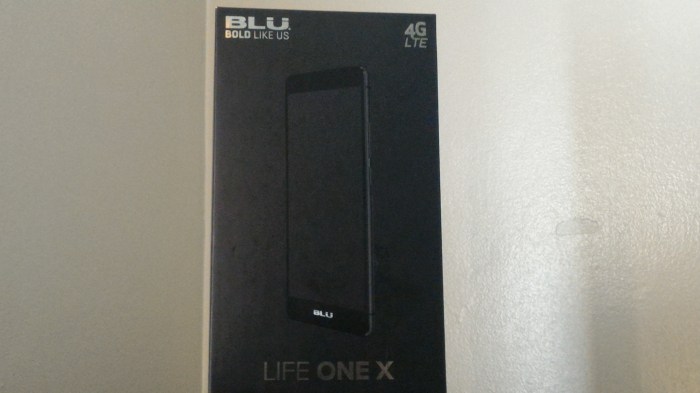
Known in the tech world as the “Budget Phone King”, many would expect an unboxing befitting the budget price in attempt to cut costs. Dare I say this is not completely the case for the Miami-based company, as the “flash factor” is present. I find it somewhat apropos as Miami is synonymous with flash and flair…I’m sending that like out to you Pitbull. More-or-less, we have a simple black rectangular box, but the 3-D device picture and sleek metallic silver branding definitely gives you a hint of style and flair. We observe this metallic silver BLU (“Bold Like Us) themed branding on both the top and bottom interior and exterior housings, the 4G LTE logo, Life One X labeling, the BLU website information (www.bluproducts.com), and FCC/Device identifications in black lettering within an adjoining white dialog box. As I often do for something notable, I give kudos, so kudos to you BLU for a nice unboxing experience.

Inside we are introduced to the phone in its plastic wrap sitting atop a velvet lined support. Seated underneath the phone, we find the standard USB 2.0 cable, charging adapter, and included headphones, all in similar wraps along with our usual manuals. Lastly, similar to other BLU devices, an included screen protector and phone case are found in the bottom of the interior housing. Low quality best describes the protector, as its not as dense or solid as a 9H or tempered one, but still nice to see its inclusion. Also, the case is reminiscent of the S-View for Samsung Galaxy phones, with an upper quadrant opening, allowing for quick view of notifications without unlocking the phone. I never found myself using it as I am not a big fan of this particular style, but again, nice to know BLU maximizes the experience with goodies not usually included by other manufacturers.

THE ENTREE: HARDWARE, SPECIFICATIONS AND PERFORMANCE
No one will mistake this phone as premium feeling, but the continued principle of solid fits so perfectly. On front we get the glossy black display with Corning Gorilla Glass 3, surrounded by a metal band and removable plastic back covering. Giving kudos once again is in order as the devices feels nice in the hand with its tapered edges, curved back that fits fabulously in the palm, and the ergonomic stylization allowing great one-hand use. Without overstating, this is not a phone in league with the HTC One M9, Samsung Galaxy S6 or Apple iPhone 6s, with their respective glass/metal bodies for the premier aesthetics and feel, but maintains a solid, simple charm.

On the right side, we find a top and bottom antenna, accompanied by the volume up/down toggle and power button. The volume toggle sits above the power button, and both have a great tactile feel. Although neither possesses distinguishing traits, I never found myself pressing one while attempting to use the other. On the left side, we find symmetrical antennas to their right counterparts and nothing else. Atop you’ll find the customary 3.5mm headphone jack sitting alone as no noise-cancelling microphone was present, and the USB port and main microphone on the bottom.

The 5.2” IPS LCD display, with a 1080p full high-definition resolution (approximately 424 pixel-per-inch density) provides a quality viewing experience. I find a close equivalent to the LG Nexus 5X as both having impressive screens, with the Nexus slightly edging out a win because of its brightness and sharper contrast. Don’t get me wrong, the Life One X boasts excellent viewing angles, but still leaves something to be desired. Possibly an uptick of sharpening and outdoor visibility may be the only thing lacking to make this one of the better 1080p, LCD screens, but still well worth the money.

Nestled on top of the front display we get the LED indicator, the earpiece and front 5 megapixel camera. I will touch more on the camera in the software section, but again, the word solid comes to mind. I never got the “oh my gosh” selfie shot, but to capture a quick picture for friends and family, or an adequate shot for social media, it will certainly suffice. At the bottom of the display, we find more BLU branding, with the noticeable subtraction being hardware navigation buttons, replaced by on-screen software ones. On the back is the 13MP camera, accompanied by dual-LED flash, and a bottom mounted grille speaker. As with other BLU devices, the speaker quality proved unimpressive with volume reaching high levels, but with distortion and devoid of great clarity. Similarly, the rear camera generates decent photos, but absent is great contrast and quality of detail. Again, solid and functional are the underlining truths to take away from the hardware aspects.

Removing the plastic back gives access to the dual-sim slots, micro-sd card slot, and the 2,900 mAh non-removable battery. I was pleasantly surprised BLU incorporated such a large battery given the size and screen resolution, and easily obtained all-day usage with above-average screen-on times; that is when the device isn’t acting buggy. Usual on-screen outputs ranged in the 3-1/2 to 4-1/2 hour range of moderate to heavy usage while checking/writing emails, viewing personal photos and video, browsing websites, taking photos, light gaming, and lots of YouTube watching. But one day, the device went berserk and flirted with full-on beast mode, after a random reboot. Even know, I’m still not sure what happened, maybe a software glitch caused something to go haywire, but I just could not drain the damn thing no matter how hard I tried. Included is a screen shot of that day, where I achieved seven (7) hours of on-screen time. The unit was scaring me so much I contacted an old priest and a young priest to be on standby in case an exorcism was needed. A clear indication of the buggy software one could incur when buying this phone. However, one aspect I actually liked quite a bit was this device sips power so efficiently when not in use. On a Tuesday during my review time, I left the phone on my desk at 97% with the screen on and screen timeout set to 30-minutes, and came back an two hours later to 96% battery remaining. Extremely impressive in my book if you ask!

Call quality falls into the okay category as incoming voice sounded clear but somewhat muted, while outgoing voice was detailed as either robotic sounding or accompanied by static interference. Data speeds in the testing area were impressive, though, with speeds averaging 27Mbps on T-Mobiles LTE bands 4 and 12. Again, I find the word solid a great way to describe the performance of the Life One X.

Powering the device is a 1.3GHz Octa-Core MediaTek processor (MT-6753), accompanied by 16GB of internal storage and 2GB of RAM, Mali-T720MP3 graphics card, and a 4G LTE support (Bands 2(1900), 4(1700/2100), 7(2600), 12(700), 17(700)) which is suitable for a majority of T-Mobile LTE bands and some AT&T bands. Although standard for other manufacturers, this is a stark deviation from other BLU devices supporting only 3G or HSPA+ speeds. The MediaTek processor demonstrates to be no match for powerhouse counterparts like the Qualcomm Snapdragon 800 series or Samsung Exynos; but, common usage will yield nice results. Additionally, by today’s standards, 2GB of RAM won’t make any jaw drop in wonderment, but my testing showed solid performance with little to no stutter. Having multiple applications opened did bog the device down, but with proper management, any hesitations in performance would be minimal. Snappy certainly is an overestimation of performance, but solid fits the description without a doubt. If we were to hop into a Delorean and go back to 2012, there is little doubt the Life One X would be viewed as an upper-tier phone of the day. Heavy gamers and photographers-in-training may want to stir clear of buying this, but for someone looking for a casual yet solid experience, it’s not a bad selection.

TELL ME MORE: SOFTWARE AND CAMERA
The words buggy and inconsistent come to mind whenever I review a BLU Device, and this is no exception. I say this with the utmost conviction, never have I reviewed a device from this manufacturer incorporating like software or devoid of glitches, and this one continues that trend. The Life One X sticks mostly to stock Android Lollipop (version 5.1); with a few icon pack tweaks, an inclusion of software customization, and other software gesturing additions. I would not call these inclusions a skinned version of Lollipop, but perhaps that is a good thing. Keeping Android closer to pure as possible is what most users appreciate, especially since the software is not at optimal performance. The included App Drawer was also a welcome inclusion, resulting in decreased need to install a third-party launcher, a big difference from previous BLU phones devoid of such feature. But, software continues to be the bane of BLU’s existence. There were several useful features included such as: double-tap to wake, screen drawing gestures to open applications, flip to silence and snooze, pocket mode, and voice unlocking, all diminished by lag and app stuttering. One such example was the screen draw gesture to open the camera, in which you would draw the letter “c” for quick access. I love this feature on all my OnePlus devices, and hoping for similar success on the Life One X. Unfortunately, the experience was marred by inconsistency in successful usage and even phantom activation. I don’t know if it was me, or if the magical camera fairy waved her wand, but this feature worked marvelously when in my pants. Trust me when I say I know possess some great photos of the inside of my pants’ pocket. Joking aside, these inclusions would be a delight if BLU provided updates to improve performance when bugs are apparent, but I am skeptical due to the company’s previous track record. The same can be said about the operating system upgrades, as we are now entering month five of Android Marshmallow, and no word from BLU Headquarters on when the switch will occur. I see this as a potential deal breaker for those looking for updates to make a more fluid experience. However, at such a great price point, many may end up overlooking this inconvenience.

Much like everything on this phone, the cameras are solid without being spectacular. The application is easy to use with almost no hiccups, and utilizes a great button layout. As stated earlier, the back camera is 13 megapixels, with a 4:3 aspect ratio, or you could drop down to 10 megapixels for a 16:9 aspect ratio. A degradation of quality is apparent in switching to the lower resolution, but proved quite nominal. One quick note about the flash I learned the hard way, it is bright and can cause some serious shadow-effect problems when used, so proceed with caution when using. I did enjoy how quickly photos were taken, with a near instantaneous render. However, I did find touch to expose quite fickle. Some of the included sample photos should show it, but if you touch on one point of a subject, you can get a near perfect shot. But if you focus just slightly off-center of that subject, there was a tendency for blown-out highlights. It was a very odd occurrence and definitely one worth noting. The back camera also records video in 720p with your choices of high, medium or low frame rate quality. I saw little difference in video quality between the high and medium settings, but a noticeable one at the low settings. Unfortunately, no 1080p video recording was included, but overall camera quality for both photo and video were; say it with me…solid.

BRING IT ON HOME: CONCLUSION AND FINAL THOUGHTS
As customary in each of my reviews, I attempt to answer the question who I would recommend this phone. Over and over I contemplated this and still have no solid answer. I guess the best answer shifts back to that word I used throughout this article: solid. If you are looking for a solid but not spectacular device at a great price, this is a device to consider. If you are not one desiring constant updates and not dissuaded by the possible lack of OS upgrades, this may be the device for you. I see this more as something a parent would buy their pre-teen or teenager as a starter phone, or for someone in need of a “filler” device until the new flagship season kicks off. I also see this as recommendation for someone traveling overseas needing an unlocked and/or dual-sim device, or for someone looking to add another decent phone to their roster. Solid, albeit with some buggy quirks, clearly defines what it is like to use the Blu Life One X. And if you are someone who can live with this, you will be pleased what your $149 buys you. One final note, if current pricing is steeper than what you would like to pay, Blu has a history of lowering prices as a device ages; so be on the look out for that in the near future.

OnePlus 2 Review: A Device Where Everything Adds Up…Almost!

OnePlus captivated consumers by producing one of the top phones of 2014, after ticking us off with the silliest invite system ever. Wait, I promised my therapist I would move on. Anyway, users and reviewers wondered could OnePlus achieve success again in 2015, with a multitude of amazing devices launched by the likes of Apple, Samsung, LG, and Motorola, just to name a few. Well, I am here to say OnePlus again stole my heart. Once you get past the self-proclaimed and overpromising Flagship Killer moniker, you realize this company possesses a firm gripe on what consumers want. This shows evident the OnePlus 2. In my opinion, arguably one of the best phones of the year and well worth purchasing.

TAKING THE TOP OFF: THE UNBOXING
Unlike last year’s OnePlus unboxing, the OnePlus 2 provides a more suitable, albeit still electrifying experience. Differing from last year’s pull-out jacket approach, this year we are greeted with a simple but stylish pull-off design. In their signature red and white stylization, we are met by a rectangular box with adorning lettering, and an impressive etch-on I can only describe as company’s new “infinity” logo. On the back, we observe the normal FCC, IMEI, and Company information regarding your particular phone identifications. Once again, the idea of simple but still very stylish comes to mind.

Upon removing the top covering, we are greeted to the phone in all its glory, enclosed in a protective plastic sleeve with the wording “ONEPLUS 2”, “NEVER SETTLE”, and the button layout indicator etchings. Underneath the device, we come upon a red jacket and inside we will find our normal array of Quick Start Guides and Manuals, which we all can’t wait to read thoroughly. Just joking! Below the manuals, are the white cutouts housing our USB type-connector cable and power adapter.

As previously stated, this unboxing experience shows OnePlus understands stylish does not need to be extravagant to enjoy. It was simple but definitely not understated.

THE ENTREE: HARDWARE, SPECIFICATIONS, AND DISPLAY
Getting back to the device, we see a gorgeous all black 5.98” overall size, with a premium looking dark grey metal band surrounding the phone frame. We find our standard 3.5mm headphone jack on top with a noise cancelling microphone and antenna, our volume up-and-down buttons with accompanying power button to the right. On back is the 13MP camera with dual-LED flash and laser optical sensor, the newly embedded fingerprint sensor/home button positioned below the display, and two grills on the bottom serving as our speaker and a secondary microphone, along with the USB Type-C port. On the front of the device we have our earpiece, ambient light sensor, LED notification light, and 5MP front camera. But one of the newest, and in my opinion, best features added is the alert slider on the left side. I know Android has software inclusions to turn notifications on or off, and also enter the phone into a silent mode, but having a dedicated button for such activities was an admirable add-on. I hope we see this in many future OnePlus devices, as well as other manufacturers should consider this a necessary inclusion. I only used it a handful of times during my testing period, but still, a very welcome addition. Much as other reviewers mentioned, no NFC is present, so this puts a damper on possible use when Android Pay and other electronic transfers becomes norm. It was not a big deal to me, as I very seldom use it anyway, but in a supposed flagship killer, there really is no excuse for its omission.

Powering the OnePlus 2 is a Quad-Core Qualcomm Snapdragon 810 (version 2) chipset (four Cortex high-powered A-53 and four low-powered A-57), coupled with an Adreno 430 and 4GB of RAM for the 64GB variant and 3GB of RAM for the 16GB variant. A little off topic, but it fascinates me manufacturers produce 16GB variants. Really? 16GB? What am I supposed to do with 16GB? Really! In my opinion, 16GB, with no SD card expansion, should be a crime against humanity! I digress, though. Also included is GPS/GLONASS, all bands of 802.11 Wi-Fi are present, Bluetooth version 4.1, USB Type-C, dual-SIM card tray (nano-SIMs). I found the performance to be more than expected for such a reasonable priced device.

Multi-tasking was a breeze with no aggressive app closings, thanks in part to the 4GB of RAM, and I enjoyed an overall fluid experience. There were a few hick-ups in daily usage, but much of that can be attributed more to flaws in the Oxygen OS software we will discuss in the next section. All-in-all, I was pleasantly pleased with the functionality and found my self enjoying web browsing, playing games, viewing videos, even writing articles, and using GPS to get around town. Without a doubt, I would give the hardware a solid “A”. Additionally, the fingerprint/home button was such a welcome addition. It is quick and easy to setup, and very responsive in its dual function. I found myself playing with it because how fascinatingly cool it was. I would not say it’s the fastest, I would give that honor to either the iPhone 6s or Nexus 6p, but the OnePlus 2 possesses one of the better ones. I also found the overheating issues of the infamous 810 chipset to be very minimal. Did the device get hot? No. Did it get warm? Sometimes when doing when heavy multi-tasking or playing graphically intensive games, but I applauded OnePlus for turning a con into a pro. Kudos! Call quality and reception were also high points as calls sounded very clear with little to no distortion, and speaker levels were well above acceptable levels. The speaker quality showed very capable during my testing period. I will never be an advocate for bottom speakers as too many shenanigans can happen (i.e. covering while playing games or videos in landscape) but the volume was on-par with other quality devices. Kudos once again, OnePlus!

Battery life proved an inconsistent aspect of an otherwise fantastic experience. I know other reviews report solid but not spectacular battery life, but I have to dispute those. My usage was hit-or-miss, with typical usage of 3-1/2 to 4 hours of moderate on-screen usage being close to normal. I did get over 6 hours of talk time (on a full charge); and yes, I am a teenage high schoolgirl from the 80s who still likes to talk on the phone for 6-plus hours. One interesting aspect of an inconsistent feature was I did get outstanding standby times. There was a Monday; I put the phone away to test another device, accidentally leaving it on after full charging. I did not even know it was on until that Thursday afternoon I heard the “low-battery” chirp. Really impressive if you ask me, but overall, I would give battery life a “C+” for inconsistency. Software updates to either Oxygen OS, or an upgrade to Android Marshmallow may rectify this problem, but be wary, for now.

Moving onto the display, I have but three words to describe it, “de-lic-ious”, I’m done. We observe a gorgeous 5.5” IPS display with a stunning 1080p (1080 x 1920, 401 ppi) resolution covered in Gorilla Glass 4. Kudos once again to OnePlus, as this display is incredible. When first observing, I honestly thought it was a Quad-HD display because of the vividness and great color rendering. I was dumbfounded when a colleague corrected me, but you see the point. Essentially, it is the same display used on the OnePlus One, but the designers did a marvelous job adjusting internal brightness and saturation levels. Looking at such a great display made the daily tasks that much more enjoyable. Kudos all around!

TELL ME MORE: SOFTWARE AND CAMERA
After the public and confusing breakup between OnePlus and Cyanogen, OnePlus was left to produce their own in-house software overlay. Queue Oxygen OS for its grand unveil! In general, I was pleased with the skin as it offered several usable features devoid in stock Android. Upon first use, it had some minor glitches including force closes of the installed messaging app, periodic non-responsiveness of the fingerprint reader, and the occasional sluggishness of memory intensive apps, to name a few. The reason these did not deter my overall satisfaction is OnePlus has been diligent pushing software updates out regularly to improve performance. So what started as often buggy and frustrating quickly turned into delightful.

If you are like me, you like to change the look of your device daily. If so, you will be elated with this mamma-jamma. Much like its predecessor, the OP2 includes several software options to change the theme, stylizations of the keyboard, adjust hardware button layout and operations, adjusting the design in the settings menu, and those are just a few tweaks. I say this seriously, if it on the phone, you have the ability to tweak it, and I really enjoy such options. It goes without saying, but I never had a dull moment playing with the customizable options. Truly, it felt like using a new device each day.

As I mention in every review, I am not much of a camera aficionado, so take my review of the camera lightly. In great lighting, I was quite impressed with the solid contrast and great detail. Additionally, the focusing proved a high point, thanks in part to the laser autofocus. Taking a shot was incredibly fluid, simple and relatively fast. Low light shots were okay with the dual-LED helping out. In general, picture quality was a solid “B”. Video was also impressive, but I did find myself frustrated by the constant auto focusing. I am not sure if this was something I was doing wrong or if it just a software issue, but I did get a little annoyed. Quality of video was actually nice. You definitely won’t make J.J. Abrahams (cheap Star Wars plug) jealous because of the quality, but the videos will be crisp and pleasurable to view.

My biggest gripe focuses around video ease of usage. There is far too many swipe up or swipe in gestures, which are similar to initiating other application functions. Often, I would swipe up or in to change a camera/video function, and all of a sudden my notification drop-down would show up, or the settings menu would initiate, little things like that. Nonetheless, I feel with continued usage, this would turn from a minor annoyance to skillful mastery.

BRING IT ON HOME: CONCLUSION AND FINAL THOUGHTS
In concluding this review, let’s look at the facts about the OnePlus 2: upper-end specs, great design and build, solid software experience, great hardware and software customizations, and a thoroughly appealing price tag. Without a doubt, this is one of my top 15 devices of 2015. Is it future proof? More or less. Is it a flagship killer? Nope. What it does achieve is it is a great device, with a great price point, you will not regret you purchased. As I always answer “…who is this for…”, and I can honestly say I would recommend this to anyone. There really is something here everyone will like with few sacrifices. Unless you just require a phone with all the top-notch bells-and-whistles, you will be very pleased. Much like the OnePlus One, the OnePlus 2 walks a marvelous line of providing a great experience and impressive specifications with a minimal price tag.

OnePlus 2 – Sample #2
OnePlus 2 – Sample #1